
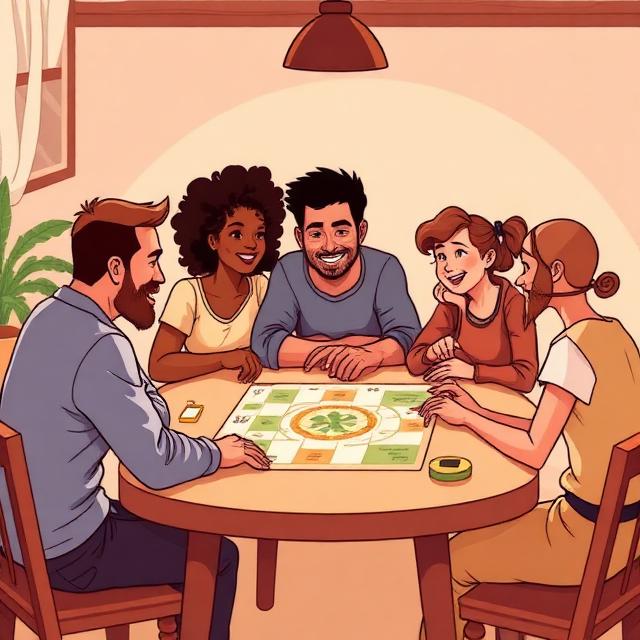
Most games reward speed, dominance, or individual victory. Win fast. Beat others. Move on.
But real life doesn’t work that way.
Families, classrooms, and communities succeed not by short-term wins, but by decisions that hold up over time—choices that balance today’s needs with tomorrow’s consequences. This is where cooperative games offer something fundamentally different.
Instead of asking “How do I win?”, cooperative games ask a deeper question:
“How do we all succeed—together, over time?”
That shift changes how people think, plan, and learn.
Competition Trains Short-Term Optimization
Competitive games are excellent at teaching:
- Quick pattern recognition
- Tactical reactions
- Individual performance under pressure
What they often don’t teach well is long-term stewardship.
In competitive systems:
- Resources are consumed for immediate advantage
- Future consequences are secondary to winning now
- One player’s success often depends on another’s failure
These mechanics mirror many real-world systems where short-term gains create long-term instability—burnout, inequality, and fractured trust.
Cooperative Games Redesign the Decision-Making Loop
Cooperative games replace zero-sum thinking with shared systems thinking.
Instead of isolated turns, players experience:
- Interdependent choices
- Delayed consequences
- Shared responsibility for outcomes
In Share the Commons, for example, every decision affects:
- The group’s future options
- Resource availability several turns later
- Whether the system remains stable or collapses
Players quickly learn that “winning fast” can actually cause everyone to lose later.
That lesson sticks—because it’s felt, not lectured.
The 4 Ways Cooperative Games Build Long-Term Thinking
1. Future Impact Becomes Visible
Players see how today’s choices ripple forward. Overuse a resource now, and the group pays later. Protect it, and everyone benefits.
This mirrors real-world economics, environmental stewardship, and community planning.
2. Planning Replaces Reacting
Instead of reacting to opponents, players:
- Anticipate shared challenges
- Coordinate roles
- Think multiple turns ahead
Long-term thinking becomes a necessity, not an abstract idea.
3. Success Is Measured Over Time
Winning isn’t about a single moment—it’s about sustainability.
Groups must ask:
- Can this system survive?
- Is everyone still included?
- Are we stronger than we were before?
These are the same questions healthy communities must ask.
4. Trust Becomes a Strategic Asset
In cooperative play, trust isn’t emotional—it’s practical.
When players communicate honestly and plan together, outcomes improve. When they act selfishly, the system weakens.
This teaches a powerful, often-missed lesson:
Trust isn’t idealism. It’s strategy.
A Real Family Example
During a family game night, one parent tried to “optimize” their moves—grabbing resources quickly to stay ahead. Two rounds later, the entire group struggled.
Their child noticed first:
“If we keep doing that, we won’t have anything left.”
The family restarted—this time planning together. The game lasted longer. The conversations deepened. Everyone stayed engaged.
That moment reframed how they talked about money, sharing, and responsibility—without a single lecture.
Why This Matters Beyond Games
Cooperative games act as practice environments for:
- Economic decision-making
- Resource management
- Collective problem-solving
Researchers in game-based learning have long shown that cooperative play improves systems thinking and collaboration skills (see work summarized by organizations like the Institute of Play).
Games don’t just entertain—they train mental models.
And the mental model of cooperation is one the world urgently needs.
When Competition Still Has a Place
This isn’t about eliminating competition entirely.
Competition can motivate.
Cooperation teaches sustainability.
The difference is this:
- Competition trains individuals to win
- Cooperation trains groups to last
Healthy societies need both—but long-term prosperity depends on the latter.
WeShare Summary
Cooperative games teach long-term thinking by making future consequences visible, shared, and unavoidable. Players learn that short-term gains can weaken systems, while collective planning builds resilience.
Families discover new ways to talk about fairness and responsibility. Educators gain a hands-on tool for teaching systems and economics. Communities practice collaboration in a low-risk, engaging environment.
The most powerful lesson isn’t how to win—it’s how to sustain success together.
Get Your Game + Community Bundle Today
Experience how Share the Commons turns play into lasting insight.
Build strategic thinking, cooperation, and shared prosperity—one game at a time.
👉 Get Your Game + Community Bundle Today