
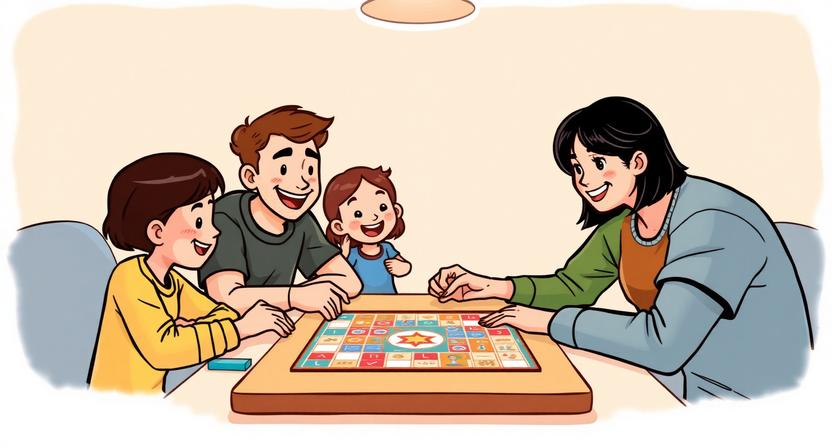
At first glance, Share the Commons plays exactly like SUPERCHECKERS.
Same core mechanics. Same movement logic. Same accessibility.
And that’s intentional.
Because the real difference doesn’t come from how the game is played.
It comes from what families notice, discuss, and carry with them after the session ends.
When families finish their first Share the Commons game, the most common response isn’t about strategy or winning.
It’s reflection.
1. The Game Ends — but the Conversation Begins
Because the mechanics are familiar, families don’t get stuck learning rules.
They get straight to meaning.
After one session, families naturally start asking:
- “Why did that decision feel helpful at first but cause problems later?”
- “Why did we struggle when we stopped communicating?”
- “Why did working together feel harder—and better—than expected?”
The simplicity of SUPERCHECKERS-style play clears space for systems awareness, not rule memorization.
Lesson learned: Simple games can surface complex thinking faster than complex rules.
2. Shared Outcomes Change How People Think About Responsibility
In competitive checkers-style games, responsibility is individual.
In cooperative play using the same mechanics, responsibility becomes shared.
Families quickly notice:
- Individual moves affect everyone
- Silence creates confusion
- Coordination matters more than cleverness
A parent reflected after a session:
“I realized I wasn’t just making moves—I was shaping the whole board for everyone.”
That insight mirrors real-life shared systems like households, classrooms, and communities.
Lesson learned: Responsibility expands when outcomes are shared.
3. Trust Stops Being Abstract
Trust is often taught as a value.
In cooperative play, it becomes a requirement.
Because success depends on coordination, families experience:
- The cost of withholding information
- The relief of shared planning
- The speed at which trust accelerates progress
Children often articulate this clearly:
“It works better when we actually tell each other what we’re thinking.”
No lecture needed.
Lesson learned: Trust isn’t just emotional—it’s operational.
4. Familiar Mechanics Highlight Unfamiliar Patterns
Because the gameplay feels known, families focus on patterns instead of moves:
- Repeating short-term decisions
- Ignoring long-term board health
- Overcorrecting after small mistakes
These patterns closely resemble:
- Financial decision-making
- Group projects
- Community resource management
The game becomes a mirror, not a lesson plan.
Lesson learned: Systems reveal themselves when the rules fade into the background.
5. Leadership Becomes Situational, Not Fixed
Without a “winner,” leadership shifts naturally.
Families notice:
- Different players step up at different moments
- Younger players offer big-picture insights
- Quiet voices often notice system risks first
This creates a subtle but powerful shift:
Leadership becomes responsive, not dominant.
Lesson learned: Healthy systems distribute leadership instead of concentrating it.
6. The Language of the Game Carries Into Real Life
Weeks after a session, families often reuse game language:
- “Are we thinking short-term here?”
- “What happens to everyone if we do that?”
- “Did we talk this through?”
Because the mechanics were simple, the mental models stick.
That’s when play turns into practice.
Lesson learned: Shared experiences create shared language—and shared habits.
Why This Approach Works
Educational research consistently shows that experiential, cooperative learning builds deeper understanding than passive instruction. According to the Cooperative Learning Institute, cooperative approaches have been shown to improve learner engagement, communication, and shared responsibility compared with competitive or individual learning structures.
By using familiar SUPERCHECKERS-style mechanics, Share the Commons:
- Lowers barriers to entry
- Centers reflection over instruction
- Lets families discover systems thinking organically
The learning isn’t forced.
It’s remembered.
WeShare Summary: What Families Actually Take Away
After just one Share the Commons session, families often leave with:
- A clearer sense of shared responsibility
- Stronger communication habits
- Natural long-term thinking
- Increased trust across ages
- A shared language for cooperation
Nothing about the mechanics needs to be new.
What changes is how people see their decisions—together.
Ready to Experience Cooperative Play Differently?
Get Your Game + Community Bundle Today and turn a familiar game format into a meaningful family learning experience.